
A System-Wide Approach to Exceptional EVS Quality Baptist Health
Overview
When Baptist Health System, one of Floridas top healthcare systems, decided that they wanted a single, proven EVS QA solution across their 11 hospitals, Walsh QA Inspector was the obvious choice. First adopted by South Miami Hospital in 2007, Walsh already had a 16-year record of success, and today, all 11 Baptist Health Hospitals are using the Walsh QA Inspector platform.
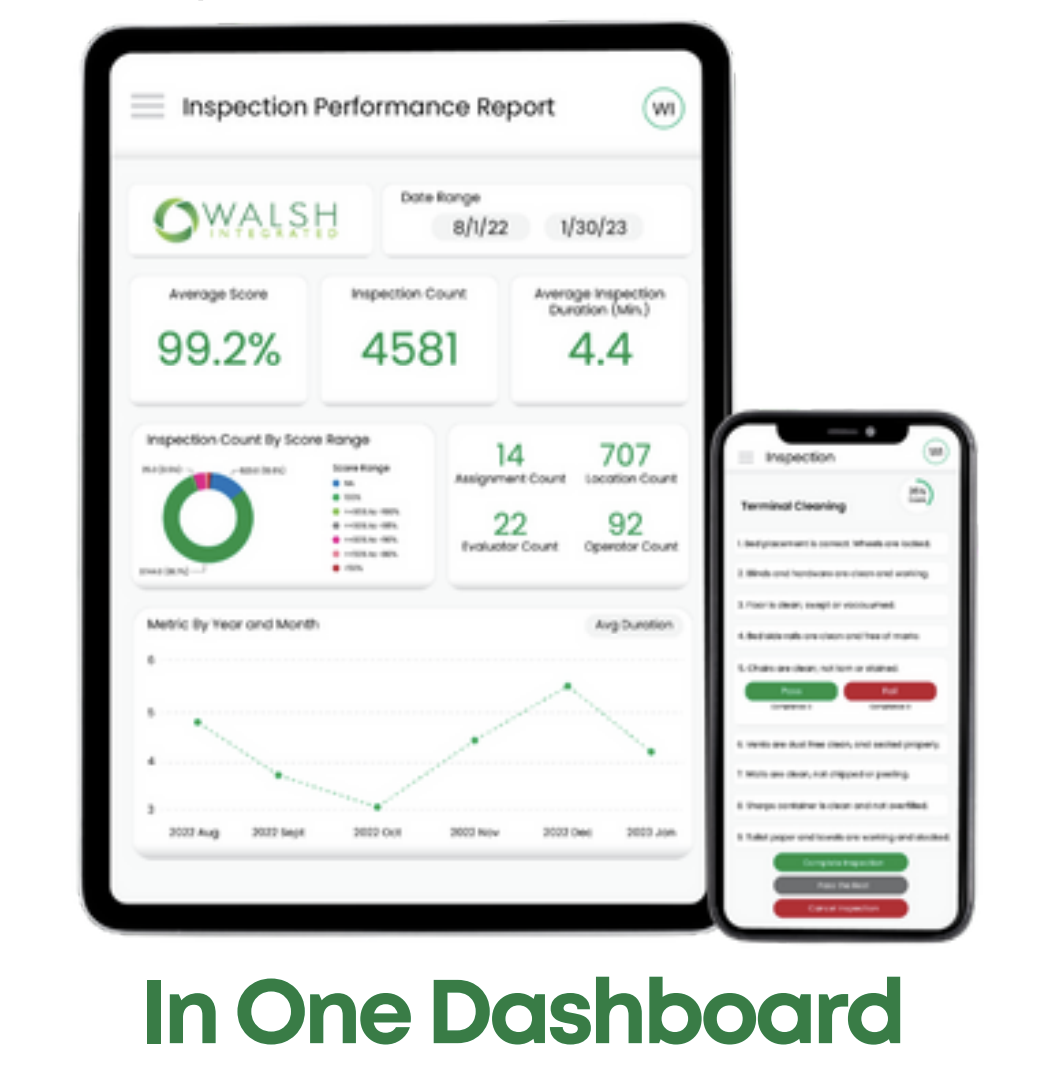
Baptist Health is now performing over 40,000 visual inspections and fluorescent marking verifications annually with Walsh QA Inspector. This single, centralized dashboard ensures consistency, accountability, and measurable improvements across all EVS teams.
The Challenge
In the past, each hospital used a different QA system, so standardization and analysis was virtually impossible.
1. Different Processes Across Hospitals
Each facility used separate checklists and scoring systems, resulting in a variety of cleanliness verifications, siloed reporting, and challenges in enforcing best practices.
2. Using the data for decision making
Because performance data was manually compiled and difficult to analyze, identifying where extra support was needed was a real challenge.
3. Single-Use Fluorescent Markers
For their fluorescent marking program, supervisors were employing single use, disposable fluorescent markers for surface testing. These were extremely costly and not environmentally friendly. Furthermore, the data could not be compared to their visual inspections nor across hospitals.
The Challenge
In the past, each hospital used a different QA system, so standardization and analysis was virtually impossible.
1. Different Processes Across Hospitals
Each facility used separate checklists and scoring systems, resulting in a variety of cleanliness verifications, siloed reporting, and challenges in enforcing best practices.
2. Using the data for decision making
Because performance data was manually compiled and difficult to analyze, identifying where extra support was needed was a real challenge.
3. Single-Use Fluorescent Markers
For their fluorescent marking program, supervisors were employing single use, disposable fluorescent markers for surface testing. These were extremely costly and not environmentally friendly. Furthermore, the data could not be compared to their visual inspections nor across hospitals
Implementing Walsh system wide
1. A Standardized EVS Program Across All Hospitals
Baptist Health has standardized on the Walsh QA Inspector program, and as a result:
-
- Inspection forms share common standards, scoring, and reporting, but can still be customized for each hospital. This allows management to see QA results in a consistent and comparable format across all facilities while focusing on the individual needs of each hospital.
- Data is stored and managed in a secure, cloud environment, allowing managers to make informed, data-driven decisions in real time.
- A single system makes it easy to understand performance across the entire organization. This is critical for benchmarking and pursuing continuous improvement. For example, each of the 58 Supervisors is inspecting for 43 minutes per week, carrying out 14 inspections, on average. This ensures consistency and accountability.
2. Environmentally Friendly Fluorescent Marking
Baptist Health replaced their single-use fluorescent markers with Walshs environmentally friendly multi-use daubers. Walshs 1 glove method reduces costs while guaranteeing that there is no cross-contamination. The result:
-
- Environmentally responsible inspection practices leading to significant savings on supply costs.
- Consistent, objective cleanliness validation across all sites.
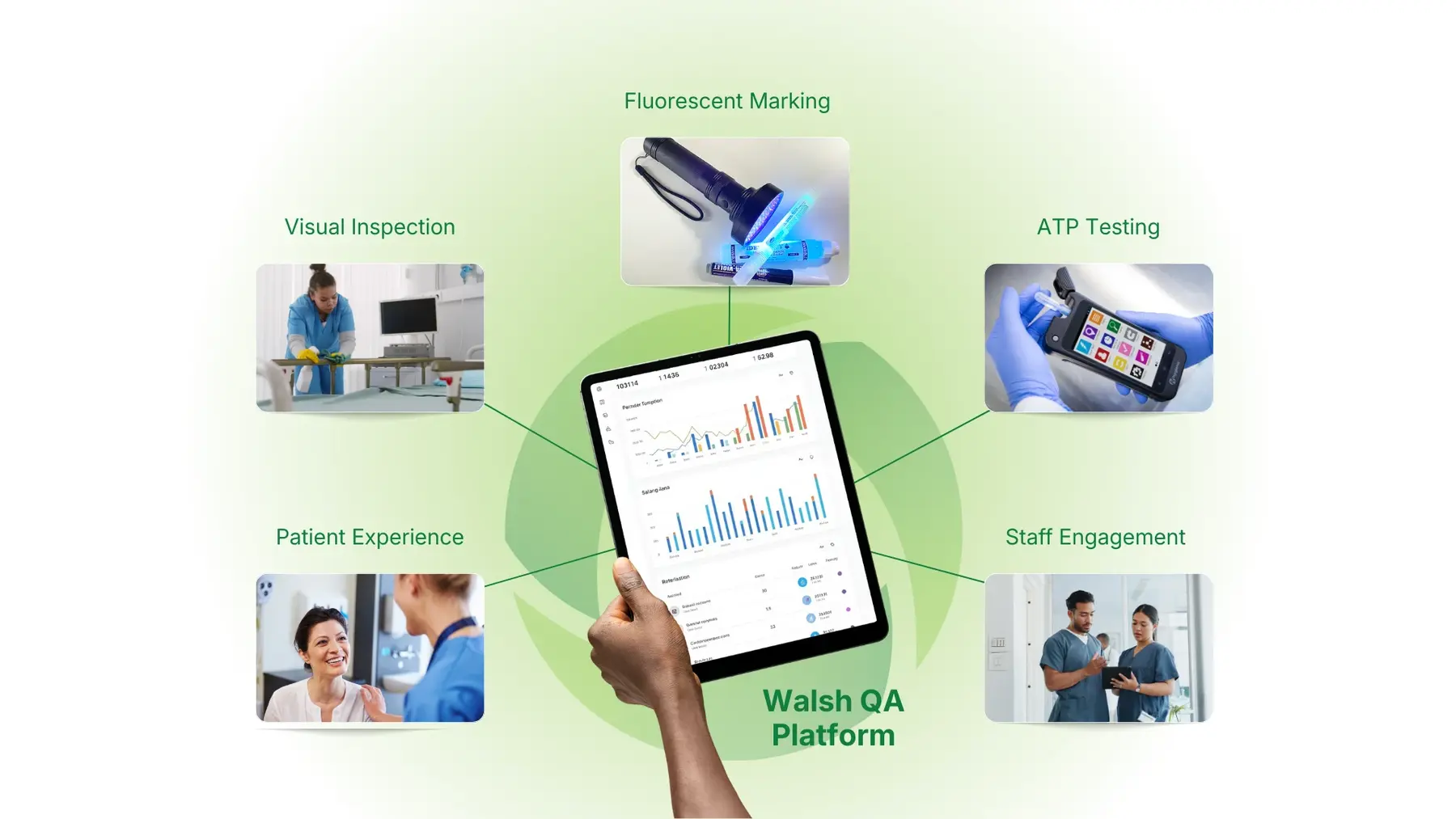
- The ability to see their fluorescent marking results in the same dashboard as visual inspection results.
3. Improved Oversight and Reporting
Leadership now accesses real-time dashboards displaying performance system-wide. This delivers:
-
- Consistent data allows benchmarking between hospitals and simplifies reporting.
- Fast and accurate identification of training opportunities and trends.
- All 11 hospitals are now “Inspection Readymeaning their reports are up to date and ready for any inspection at any time.
Walsh’s Roll-out & On-site training
- Walsh’s rollout program took care of all data collection, input, and coordination amongst all the facilities. This resulted in a painless and on-time launch.
- Walsh provided on-site training, ensuring that all supervisors and managers on all shifts received face-to-face training, covering software AND inspection best practices.
- Walsh followed up, reviewing setup and data over the first 90 days, making system tweaks and changes as needed.
The Outcome
System-wide scale and consistency
EVS teams are now completing over 40,000 inspections annually, across 11 hospitals. All 58 inspectors are contributing within the same framework, with consistent cleanliness standards and successful adoption of shared best practices.
High inspection productivity with a manageable workload
Inspectors are averaging about 14 inspections per week and 43 minutes of inspection time per week, indicating that the workflow is efficient enough to sustain large inspection volumes without overburdening staff. Inspecting consistency indicates that processes are repeatable regardless of who is managing the team, reinforcing the message of uniform methods and “inspection ready” status across all hospitals.
Data visibility for leadership oversight
System-wide data totals and averages demonstrate the kind of real-time, comparable metrics that enable benchmarking and data-driven decision-making.
Efficient, repeatable inspection process
The system-wide average of roughly 3 minutes per inspection shows that standardized forms and workflows keep each inspection brief while still producing high scores; the Walsh platform reduces waste and simplifies documentation.
Streamlined QA operations across 11 hospitals
Consistency in inspection methods, scoring, and documentation
Walsh Fluorescent Markers reduce their environmental impact and costs
Centralized dashboards provide real-time oversight and comparison
All QA efforts are now visible in a single platform, allowing new and powerful insights
Summary
With the adoption of Walsh QA Inspector across all 11 hospitals, Baptist Health has evolved from independent, QA programs to an integrated, data-driven QA system. By standardizing visual and fluorescent marking inspections, the organization is achieving sustainable, cost-effective, and consistent performance validation across every hospital.
The Walsh QA Platform continues to help Baptist Health strengthen compliance, reduce waste, and maintain excellence in patient safety and environmental hygiene.
View the PDF version of this case study here:
Let us show you what we can do.
Ready for a demo or custom quote? Our product specialists are happy to assist you.